
Call them the new hot tub. Sauna-cold-plunge setups are super trendy right now. Here’s what you need to know before putting one in your own backyard.
By David Lennam | Photos by Jeffrey Bosdet (unless noted)
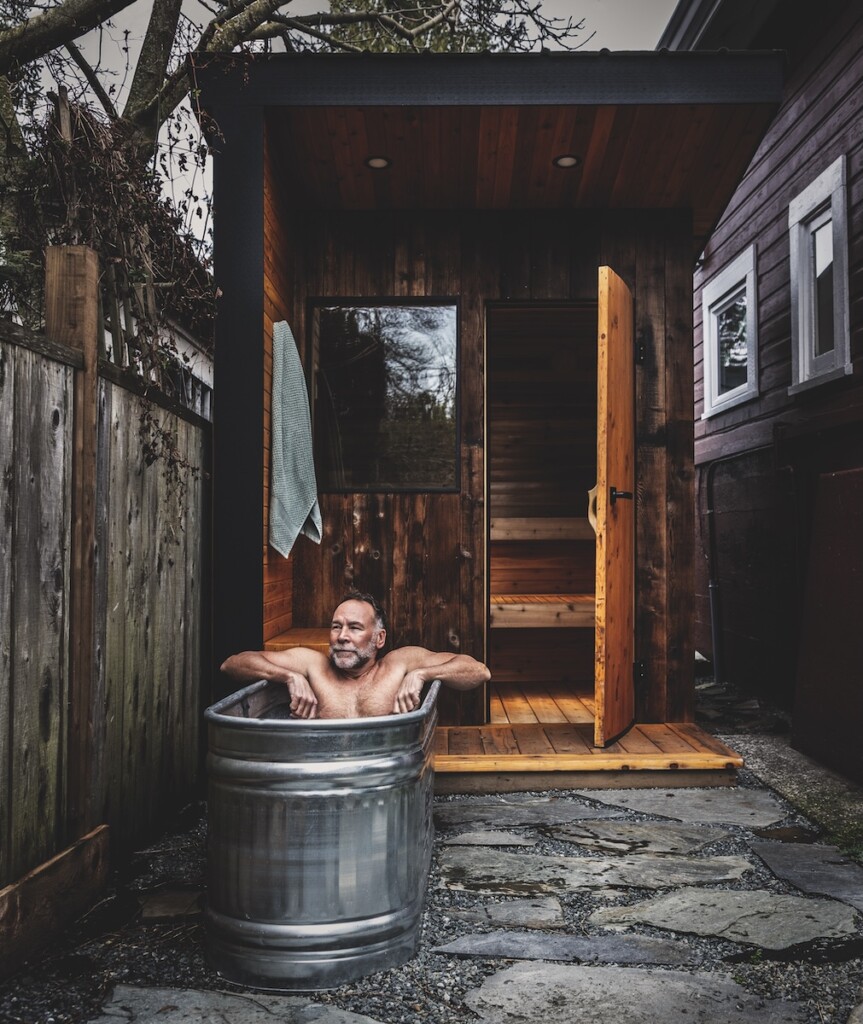
My wife and I had been testing the benefits of hot and cold therapy for some time, spending a small fortune at all the hot-cold hotspots, those suddenly ubiquitous cold-plunge-to-sauna-repeat spas like we were a couple of obsessed Finns longing for the old ways.
The science behind a sauna-cold-plunge combo is time-tested: it boosts energy, increases circulation, enhances immune function, promotes faster muscle repair, burns “brown” fat for weight loss, improves skin health, reduces stress, gives better sleep, puts you in a buoyant mood — and, hey, it just feels good (especially the sauna part).
Cold plunge is all about training and resetting the nervous system, muscle recovery (think about all those pro athletes who bathe in ice after a game), endorphins for days.
The sauna itself is more about a cardiovascular tune-up, plus relaxation.
And the social aspect should not slip by unmentioned. Simply, sauna is a nice way to spend time with people.
After our extensive field testing, we concluded that it was definitely for us. So much so that we hired builders to create the experience in our backyard, a trend that seems to be catching on.
Big Heat, Small Space
We came up with a plan that was only marginally extravagant: a comfortable setup that would allow us to indulge, day or night, or day and night, without having to get dressed or find parking.
Victoria-based Azbowa Homes was already doing some work for us, manufacturing a sliding gate system and repairing an aging fence, when we asked whether they’d be up for fabricating a sauna. It would be their first for a client so there was a learning curve to ride.
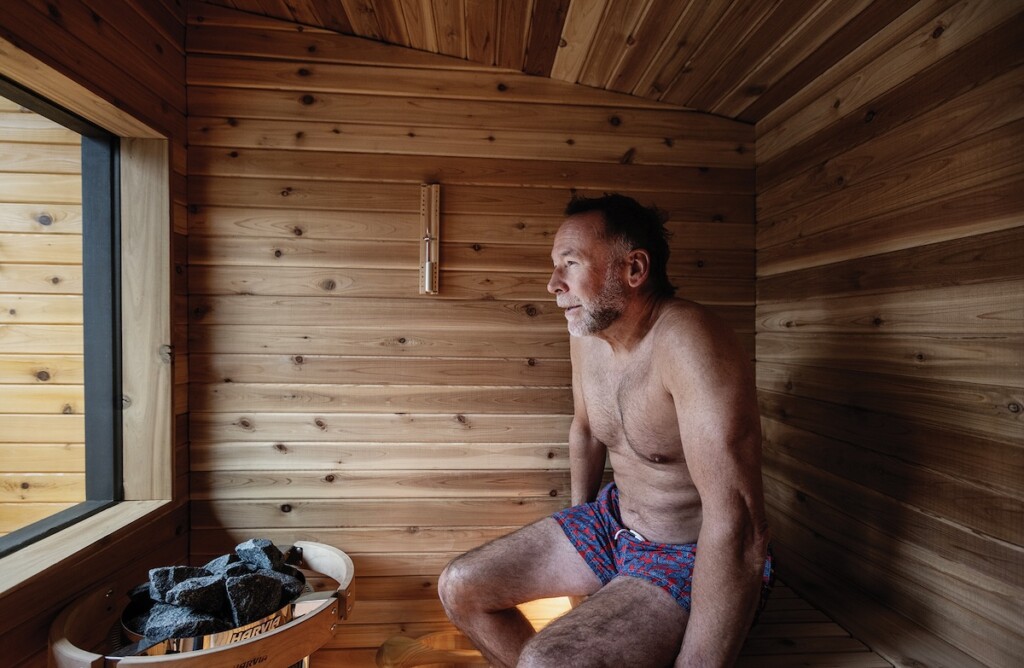
The biggest challenge-slash-difference from home construction was compensating for extreme heat and moving air around a small space.
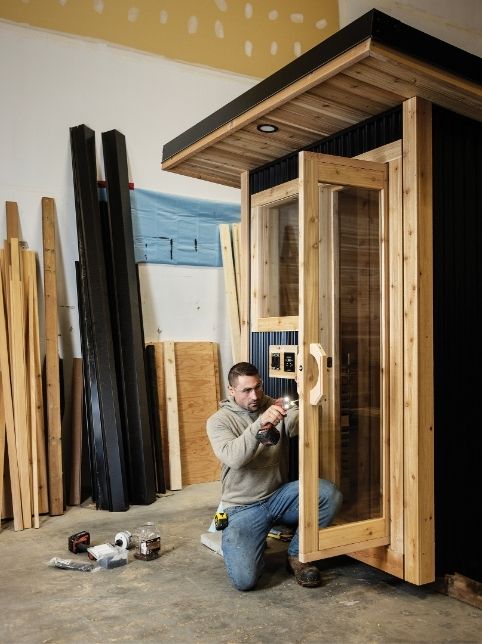
Azbowa’s co-owner and lead carpenter Ryan Hamilton talks about how every single material — right down to the fasteners — had to be able to handle the temperature, while consideration had to be reserved for critical airflow.
“It’s almost science, which might be a big word,” he says, “but it’s the mechanicals you don’t really have to think about when building a shed or even a house. The types of screws, the placement of the screws, the placement of the insulation in the floor, where to put our holes and afterwards we had to play around with the airflow.”
It required plenty of research. And a bit of let’s-see-how-this-works.
“It’s hard to picture exactly until you do it,” Hamilton admits.
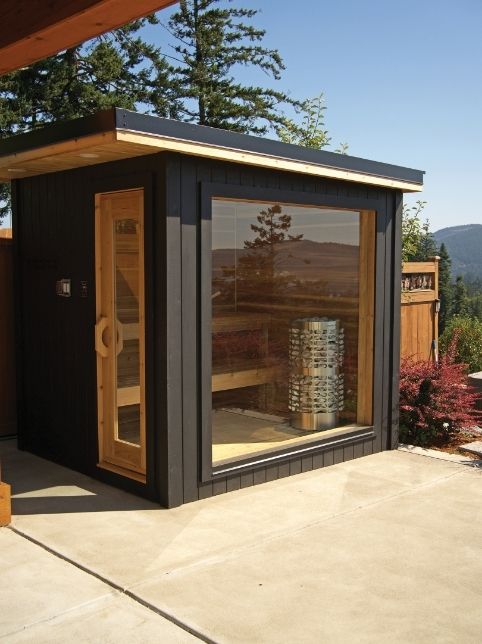
The finished product is gorgeous. A surprisingly spacious five-foot, six-inch square interior made from cedar, a hydrophobic wood that’s best for dealing with heat and moisture, but one that’s invitingly aromatic. Heat is from a Harvia 6kW electric unit, which accepts water sprinkles to produce a soothing bath of steam.
The exterior was repurposed from our old Douglas fir fence panels, then charred to achieve that Japanese esthetic of shō sugi ban.
A lot of thought went into the door, the biggest potential loss of heat. Azbowa sourced inch-and-a-half thick 100-year-old fir that once comprised the rafters in old Esquimalt military housing.
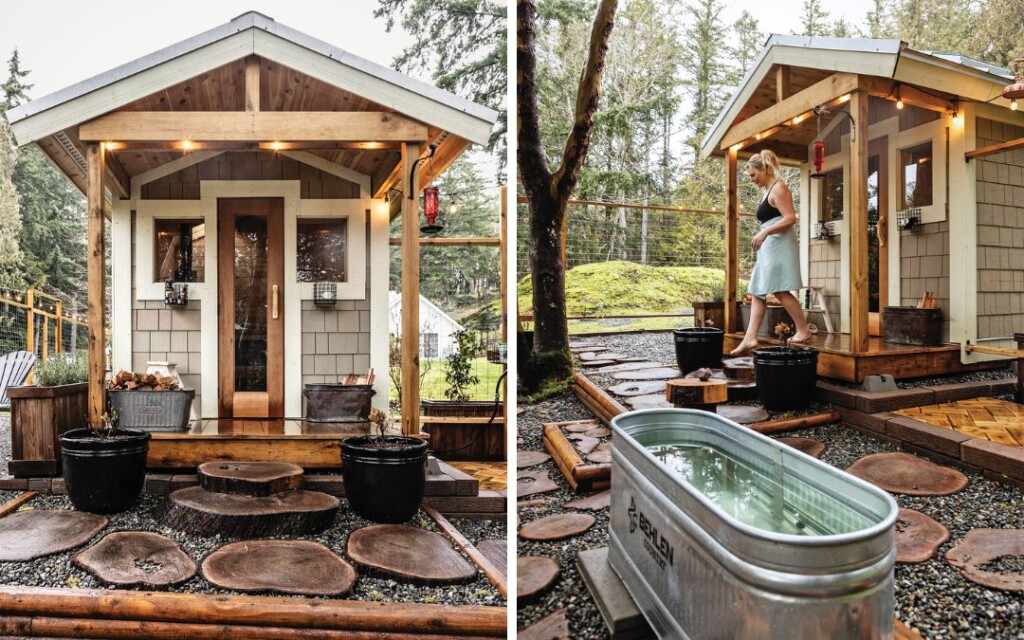
Who says a sauna needs to be a model of stripped-down Scandinavian minimalism? When Kristi Dupuis decided to build her own sauna on her property in Metchosin, she decided to take things to a whole different — and utterly charming — level. For the practicalities, she consulted with Josh Dupuis of Wildwood Saunas (no relation), but at the end of the day the design inspiration was all her own. With elements of Craftsman and modern farmhouse design, it is a beautiful, sturdily built place of wellness and healing, where she can sweat out her cares and find inner peace.
Taking the Plunge
Josh Dupuis has probably built more saunas than anyone else in town — more than 200 of them since incorporating his Wildwood Saunas in 2022.
It all began when he tried to rent a sauna for his family one Christmas and, frustrated by the lack of options, ended up building his own.
“I said, ‘I’ll just build my own in the backyard. How hard can it be?’ Turns out it was a bit harder than I thought — just details you don’t think about. But we used it a ton. We’d jump in the ocean, then run back to the sauna, then look at the stars, then go back in the sauna. I got addicted.”
It occurred to him that if he had become so easily addicted, wouldn’t other people?
Dupuis started out building mobile saunas and parking them at local beaches. They were wildly popular, booking out months in advance.
“The amount of traction we got was insane. The demand was just crazy. People were tripping over themselves to get a seat in the sauna.”
When municipal bylaws put the brakes on mobile operations, Dupuis got turned onto Bilston Creek Farm in Metchosin and made a deal to lease space for a significant sauna/cold plunge setup where the addicted could get their fix. He has since expanded to Ucluelet and Parksville, just as other operators are setting up similar outfits up and down the Island.
Dupuis has three sauna sizes he typically builds for private clients (five by five, six by seven, and eight by six feet), but is fine with custom jobs, be they sleek modern designs or something more rustic, with either wood-fired or electric heat systems.
“The biggest one we’ve done is nine by 11 feet, with a corner glass window,” he says. “We push ourselves. We’ll add stargazers, windows on the ceiling and corner glass — things other companies would choose not to do because it’s too difficult.”
Cold plunge tanks have boomed along with his sauna business.
The cold plunge we decided on was a budget version, a 100-gallon galvanized oval stock tank filled with the garden hose. It works just fine for us. But if cost isn’t a factor, Dupuis will build you a deluxe unit — insulated aluminum tubs wrapped in cedar with a commercial chiller so you can choose your level of cold. They feature pool pumps to filter and circulate the water. Add an outdoor shower or rain bucket for a breathtakingly icy dump of water over the head.
When Dupuis started the sauna biz, customers were iffy about adding a cold plunge.
“At first they hemmed and hawed,” he says. “Now every third sauna I sell, they want to pair it with a cold plunge.”
Communal Elation
I didn’t mention that my wife and I began our sauna cold plunging at Wildwood’s Bilston Creek Farm locale. We were newbies who quickly became regulars. There was a real social scene in their 12-person sauna with giggles and stories mixing with the sweat. It didn’t feel weird or unusual to share our time in the hot box with strangers. We were all there for the wellness, the stuff of science, but equally the way sauna brings elation and, in this case, a communal elation.
My wife sums it up pretty nicely.
“I never imagined myself jumping into a tub of icy water on a snowy day in December, but it’s one of my favourite memories. There we were, almost stark naked next to a forest, with the snow falling all around us and I never felt more alive.”
Before You Install a Sauna
Ask yourself the following questions:
- Do you have enough space? Two-person cube saunas typically start at five by five feet.
- Will your municipality allow you to build a sauna on your property? Most jurisdictions allow for outbuildings under 100 square feet without a building permit.
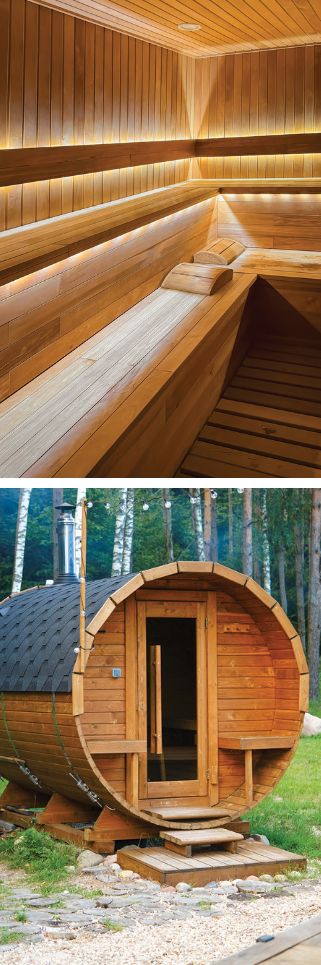
- What shape of sauna appeals to you: barrel or square?
- Should you choose wood or electric heat? Does your municipality even allow you to burn wood?
- Will your home’s electrical panel support the capacity for a sauna heater? Note: A five–by-five-foot sauna would likely need a 30 amp breaker. A bigger sauna, say, six by seven feet, needs a 40 amp and anything larger would require a 50 amp breaker. Wiring should always be done by an electrician.
- How high and how deep do you want your benches? Do you want to be able to lie down or have more depth for comfort? Maybe consider what the Finns call “the first law of löyly,” a design principle that feet should be above the stones for maximum heat absorption.
- Do you want to add LED under-bench lighting, towel hooks, a thermometer or even an audio system?
Why Hire a Pro?
There are numerous ready-to-assemble sauna kits on the market, but we concluded it would be better to have professionals build our sauna, from scratch, and not just because we’re not the handiest folks around. (I’m just above the crow in tool-use capability.)
Sauna construction, notably for outdoor builds, prioritizes insulation. That’s where custom construction trumps the kits. Kits generally come with very thin foam board. According to Ryan Hamilton, co-owner and lead carpenter of Azbowa Homes, that translates into maybe an R-10 insulation rating, “if you’re lucky, and six months of the year that’s just not going to cut it.”
The insulation in the sauna Azbowa built us was, they joke, “borderline overkill” at an R-21 value, featuring minimal air loss through walls and ceiling.
“Essentially we built it as if it was a passive building — trying to keep the entire envelope a continuous envelope from foundation all the way to roof,” says Azbowa’s co-owner/CEO Alexandre Cunow Wicks. “I think that’s something that would get missed in a kit.”
He explains that, during a windstorm, air would find those areas in the envelope that aren’t continuous and push cold air in while drawing heat out.
Once you have that proper shell, the rest is just mechanical, says Hamilton.
“Buy the wrong heater? We can change that. Want to move the benches? We can do that. But once your walls are all sealed up, that’s the insulation you have and that’s what’s really going to make the difference in the efficiency of it.”
Part of which is ventilation, stresses Cunow Wicks.
“If the insulation is great, but you don’t have proper ventilation, then you’ve got condensation building up between your insulation and the inside of your wall and you’re going to end up having mould and rot eventually.”


